Blog
Does an ATS Really Reject Your Resume? Here's What Actually Happens
An ATS does more than scan resumes. Here's what happens when you submit an application, how resume parsing works, and when automated filters can actually remove candidates.
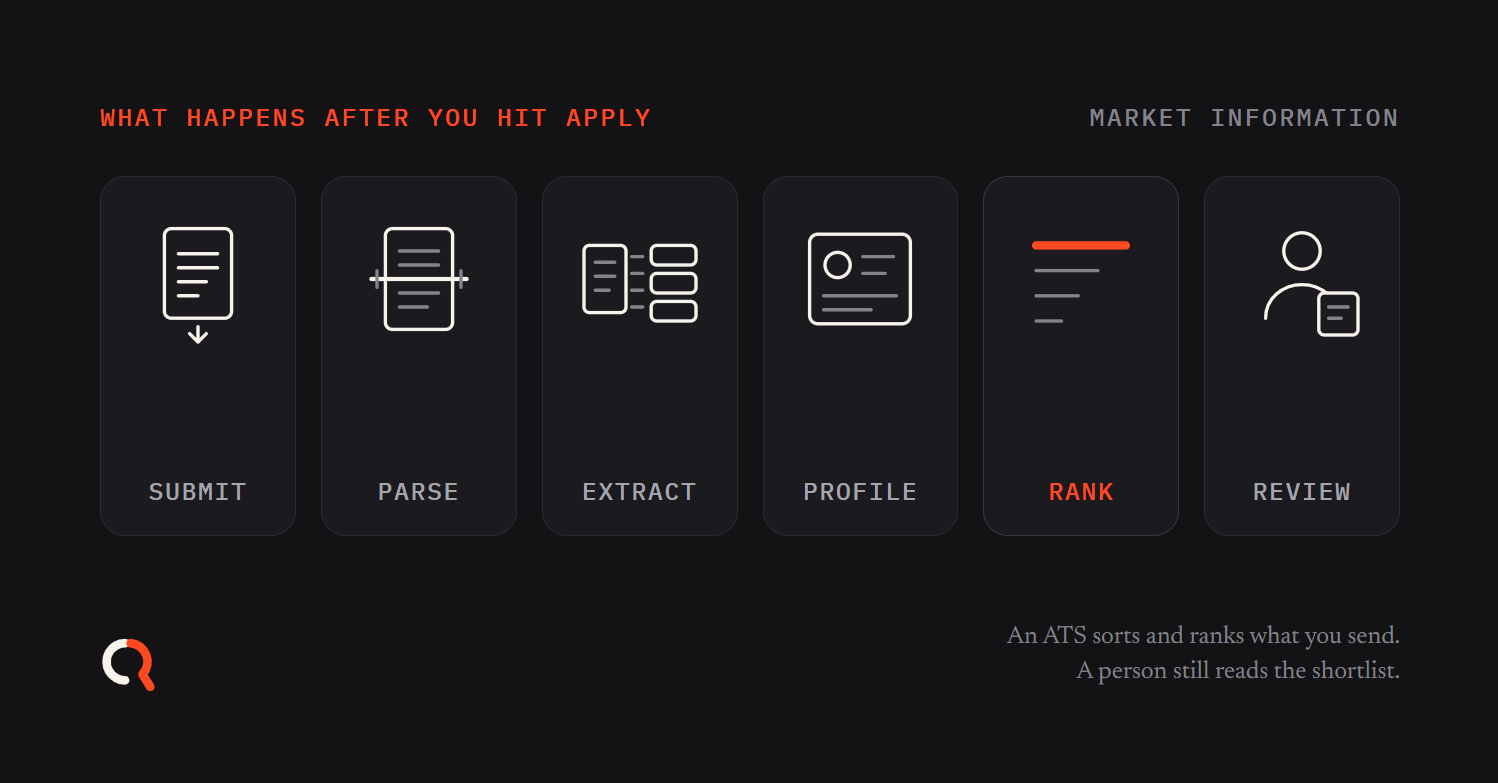
An Applicant Tracking System (ATS) is software companies use to manage job applications and organize candidates throughout the hiring process.
Instead of keeping candidate information across separate tools, recruiters can use an ATS to manage applications, track candidates through the hiring pipeline, and record information generated during the recruitment process. Greenhouse's ATS glossary
The important point is that an ATS is not simply a resume-scanning tool. It can support multiple stages of recruitment, including application management, candidate screening, interviews, feedback and hiring decisions. Greenhouse's explanation of ATS functionality
This distinction matters when someone says, "The ATS rejected my resume." The software may process, organize or help filter an application, but that does not necessarily mean the system independently made the final hiring decision.
What happens when you submit your resume?
When you apply for a job, your resume and application information can enter the company's ATS.
The system may then extract information from your resume and place it into structured fields in your candidate profile.
This process is called resume parsing.
For example, instead of leaving your resume as one document, a parsing system can identify information such as your:
- Name
- Contact details
- Work history
- Other relevant candidate information
The goal is to make that information easier for the hiring team and the recruiting system to use.
This distinction matters because parsing is not the same thing as rejection.
A system can process your resume without automatically deciding whether you should be hired.
Does an ATS actually reject your resume?
An ATS can automatically filter applications, but it does not necessarily reject a resume simply because of its formatting.
But the popular explanation that an ATS automatically rejects resumes because of bad formatting is too broad.
A 2025 study by Enhancv interviewed 25 U.S. recruiters across industries, with participants working at organizations that used more than 10 ATS platforms, including Workday, iCIMS, Greenhouse, Bullhorn, BambooHR, SuccessFactors, Teamtailor and Phenom.
Of those 25 recruiters, 23 said their systems did not automatically reject resumes because of formatting, content or design. Two recruiters reported that their systems had content-based automatic rejection configured.
That does not mean every ATS works the same way.
It means you should be careful with the statement:
“The ATS rejected my resume.”
In many hiring processes, the ATS is being used to organise, filter and prioritise applications, rather than automatically reject every resume that does not match perfectly.
Enhancv found that some recruiters use match scores and filters to prioritize which candidates get reviewed first. A low score does not necessarily trigger automatic rejection, but in high-volume roles, it can push an application lower in the review queue. Enhancv's recruiter research on ATS rejection
What can automatically filter you out?
Yes. An ATS can automatically filter candidates when an employer sets knockout questions or eligibility requirements for a role. These requirements can include conditions such as work authorization or required qualifications. Enhancv's recruiter research on ATS rejection
This is different from a resume simply being rejected because of its visual design. An eligibility filter is an explicit hiring rule configured for the application process, while resume formatting may affect how information is extracted or reviewed.
Why does resume formatting matter?
Formatting can still matter because your resume needs to be read correctly.
Resume parsing works by extracting information from a document and putting it into structured fields.
That means the goal is not to create the fanciest resume possible.
The goal is to make the important information clear.
For example, your:
Work experience
should clearly show:
Company → Job title → Dates → Responsibilities or achievements
Your:
Skills
should clearly identify the skills you actually have.
Your:
Education
should be easy to find and understand.
Simple structure also makes the document easier for a human recruiter to scan.
But be careful with claims such as:
“Using a table will automatically get your resume rejected.”
That is much stronger than the evidence we have established here.
A formatting problem may affect how information is extracted or displayed, but that does not automatically mean the ATS will reject the application.
What should you do with your resume?
The safest approach is simple.
1. Make the important information easy to find
Your name, contact details, experience, skills and education should be clearly organised.
2. Use standard section names
Don't make a recruiter guess what a section means.
“Work Experience” is clearer than something like “My Journey.”
3. Match the resume to the job
If a job requires Python, SQL and Power BI and you genuinely have those skills, make sure they are clearly represented in your resume.
Don't add skills you don't have just because they appear in the job description.
4. Focus on evidence
Instead of:
Responsible for data analysis.
Show what you actually did.
For example:
Built a Power BI dashboard to track monthly sales performance.
5. Don't design for the ATS alone
Your resume still has to work for a person.
A recruiter should be able to understand your experience quickly after opening the document.
Monster recommends keeping the core resume sections clear, including contact information, summary/objective, work experience, skills and education. Optional sections such as certifications, awards and volunteer experience can be added when relevant. Monster's resume sections guide
The bigger lesson
The ATS is not a mysterious robot sitting between you and a job.
It is part of a larger hiring workflow.
It can collect your application, extract information from your resume, help recruiters manage candidates and support filtering or prioritisation.
Some hiring systems can also apply automatic eligibility or content-based rules. But the idea that most resumes are simply rejected by an ATS because of formatting does not match the recruiter research we found.
So instead of asking:
“How do I trick the ATS?”
ask:
“Can the system and the recruiter clearly understand what I actually offer?”
That's a much better way to think about your resume.
Sources
ats · ats-friendly-resume · resume-parsing · job-applications · resume-formatting · applicant-tracking-system · resume-tips · job-search